|
Ritchie Blackmore Temple of the King: 1975-1976 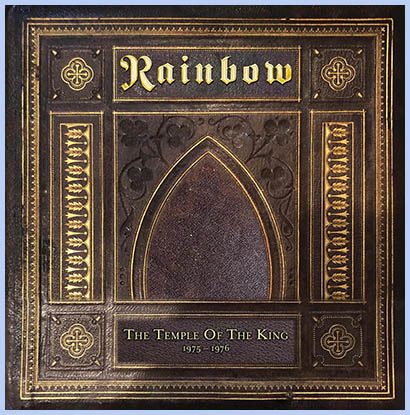 What's Ritchie Blackmore Up to Now? The guitar legend recently released Temple of the King: 1975-1976, a nine disc box set that revisits his first two albums with Rainbow. In addition to 1975's Ritchie Blackmore's Rainbow and the group's second album, Rising, which was released in 1976, the set also features three complete live concerts from the period. An additional disc of rarities rounds out the box set, which includes a book that has an essay with Blackmore's recollections of the time period. Temple of the King is the first installment of a planned series of anthologies of Blackmore's work. The guitarist has remained active, most often making music with his wife, Candice Night, with their group Blackmore's Night. Blackmore's Night had to cancel a short run U.S. tour dates last fall after the guitarist developed health issues only two shows into the run. He tells Ultimate Classic Rock now that the severe vertigo issues that caused him to come off the road were "the worst thing I've ever been involved with." 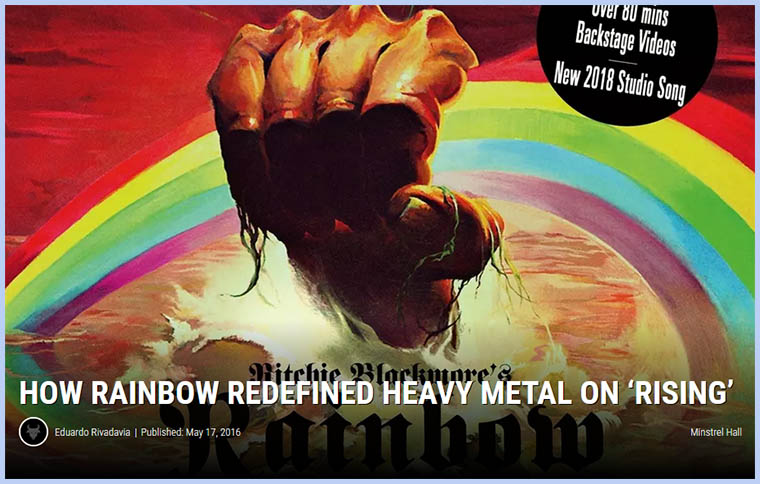 As Deep Purple's guitarist, Ritchie Blackmore played a big part in the development and popularization of heavy metal in the early '70s. These accomplishments would have been enough to secure Blackmore's credentials, but by the decade's halfway mark, Blackmore had quit Purple and started exploring new avenues in heavy music with his next band project, Rainbow. Ironically, this new enterprise had first come into being rather accidentally while Blackmore was still in Deep Purple, when a casual recording session for a solo single to be sung by Ronnie James Dio unexpectedly evolved into a full album, released in mid-1975 as Ritchie Blackmore's Rainbow. But it was arguably the following year's Rising, which, in many ways, represented Rainbow's true debut, thanks to a largely reshuffled lineup whose talents were capable of bringing Blackmore's vision to fruition. Whereas the informal nature of Rainbow's debut meant Blackmore had been content to utilize the members of Ronnie's backing band, Elf, Rising would feature a new cast of name players, hand-picked by Blackmore -- namely bassist Jimmy Bain, keyboardist Tony Carey and drummer Cozy Powell. It was this soon-to-be definitive (if typically short-lived) Rainbow lineup that arrived at Munich's Musicland Studios in February of 1976 to begin work with longtime Deep Purple producer Martin Birch (later Iron Maiden, Blue Oyster Cult, etc.). Having already spent a few weeks in band rehearsal (in a farmhouse outside Munich), the recording process was surprisingly short, according to Powell, who was quoted as follows in Jerry Bloom's unauthorized Blackmore biography, Black Night. "I think the idea was to try and capture it as quickly as we could. It wasn't a manufactured record. It was done spontaneously and the musicians' input is the way you hear it which is why is possibly why it's one of the better albums that we did." Eyewitness and photographer Raymond D'Addario, also quoted in Bloom's book, was in agreement, saying "There wasn't much said but there was a lot done. The melody and track would be in the air for a couple of days and all of a sudden Ronnie would be gone with his pen and paper and then he'd come down and just sing it and not spend hours doing it. They had a great writing chemistry." This was even true of the album's seemingly ornate opening cut, "Tarot Woman," which set the album's ambitious and mystical tone with the help of a virtuoso synthesizer intro from Carey, but was, according to the keyboardist himself, hardly belabored over. Likewise quoted in Bloom's book, Carey said that "everybody left and I sat with Martin for an hour and a half. Blackmore," he insisted, "never said a word, never told me which instrument to play, he said 'Just play what you feel.'" This organic aesthetic carries through on ensuing side one tracks, "Run With the Wolf," the potential single (and easily Rising's weakest link) "Do You Close Your Eyes," and the groupie diatribe "Lady Starstruck," which apparently told of a particularly aggressive French woman who had been stalking Blackmore across Europe. Quoted yet again in Bloom's book, Blackmore called the young lady "a real lunatic. We play a concert in Paris and she'd be there [then] we'd fly to Lyon and she'd be at the airport waiting. One day I looked out of my window and thought I saw bushes move in the garden. I kept watching and sure enough she'd found my house, so I set my dogs on her!" No wonder Blackmore chose to "escape" to Germany for Rising's recording. He also escaped worldly subject matter (with help from Dio) on the album's twin eight-minute epics, which dominated side two. The first, "Stargazer," has gone down as perhaps Rainbow's signature creation, thanks to its mystical lyrics about an ego-maniacal wizard and his "tower of stone." This evocative Dio tale was set over stately rhythm and a central riff that originated on a cello (an instrument Blackmore used to lug around and tinker with, though he never really mastered playing it), making it all the more fitting when the Munich Philharmonic joined in for its dramatic conclusion. The second was cryptically named "A Light in the Black," served as something of an unofficial sequel to the "Stargazer" story, and barreled through at breathless, break-neck speed metal assault to Rising's cathartic conclusion, merely 33 minutes after it had all begun. Together these final tracks (and, to a lesser degree, the first two), helped Rainbow establish the so-called "castle metal" style, which Dio, if not Blackmore, would carry on exploring for much of his remaining career -- to say nothing of the countless bands inspired to do the same after first hearing Rising. The record was an instant critical and commercial success upon release, and even half a decade later was being voted the number one heavy metal album of all time by the readers of British magazine Kerrang!, remaining in the genre's fundamental canon unto the present day. And how could it not? After all, in its grooves, Blackmore and Rainbow managed the seemingly impossible feat of infusing heavy metal's monochromatic shades of black with every color of the Rainbow. 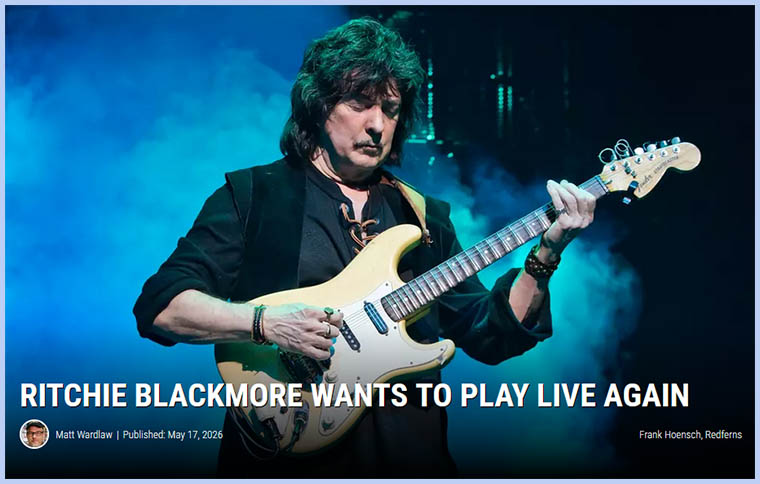 Former Deep Purple guitarist and Rainbow mastermind Ritchie Blackmore has always loved performing live. For the past 25 years, that's often meant something very different than what fans came to expect when they saw him play live with his main group. In that time period, Blackmore has indulged and further followed his true muse with his wife Candice Night in the band Blackmore's Night. Their albums and concerts focus on a shared love of the tradition of Renaissance and folk-rock music. Last year however, it appeared like his time on stage might be coming to an end. Their most recent tour in 2025, celebrating the quarter-century milestone of their group, had to be cut short due to health issues that he experienced while they were on tour. During today's conversation, Blackmore offers an update on his current health and how he hopes to return to the concert stage. But he also looks back at his history with Deep Purple and how it led to the birth of his next band, Rainbow. A new box set for the latter, The Temple of the King: 1975-1976, offers a deep dive into the group's first two albums, 1975's Ritchie Blackmore's Rainbow and Rising, which followed in 1976. A lavish booklet features liner notes by Rich Davenport, detailing what was going on with Blackmore and Rainbow in that time period and the set also includes three complete live shows from Nuremberg, Koln and Dusseldorf. There's also a bonus disc of additional rarities. In total, there are nine discs of material for fans to dig into, an appropriate deep dive. Though interviews with Blackmore are rare these days, he agreed to field our questions, often giving lengthy answers that were thoughtful in tone and even sarcastically humorous at points. He even discussed, for the first time, the night that he was replaced by Christopher Cross in Deep Purple. In the first part of our conversation, he details his health struggles and talks about his decision to leave Deep Purple, which opened the door for his future path with Rainbow. Hey, Ritchie, thank you so much for doing this. It is greatly appreciated. To start, how are you feeling? Because fans, of course, have been concerned about your well-being, following your recent health struggles. I woke up one morning when we were on tour and I had what is called vertigo. I don't recommend it to anybody. It was the worst thing I've ever been involved with. I've had heart problems, gout problems and pain, but vertigo is the worst thing I've ever been involved with. You're very dizzy to the point of where you have no control over any part of your body, and you just fall down, basically and you can't even think properly. It's almost like a stroke, but you can speak and you can understand, which is different to a stroke and I had that in a hotel. I was taken off to the local hospital, where they kind of gave me the cure for vertigo. It's called epi movement [also known as the Epley Maneuver]. You have to move your head to the left and right and you have to take antihistamines, believe it or not. Taking those antihistamines is like taking something for seasickness. It's like seasickness when you're at sea. It was like I was in a fishing boat at sea in the biggest gale you could imagine. I had to grab hold of anything I could find, like a chair to stop from falling down. That scared the hell out of me. So we canceled the tour after that, came home and then it hit me again two days later, and it's not something I recommend for anybody to have. Because I always thought when people talk about vertigo, they're talking about, oh yeah, you feel a little bit dizzy. But it's not that. You think your whole world is ending right there. Every day now, I'm looking to the left and right and straining my neck, because that's where it's all coming from. But it's a bit of a mystery. I've found that at my age, being 150, that you know, it's time to kind of pull back on touring. I do not like traveling anymore. I love playing to anybody on any stage. But to get to that place, sometimes the traveling makes me sick. When I was a child, and I would go with my mother on the Royal Blue to Bristol in England, to where most of our relatives lived, I would always throw up. I would be the age of nine or 10 and maybe that is what made me have a phobia about traveling. Now I seem to have a phobia, almost about traveling too far, leaving the comfort zone of one's home. It's a very strange ailment to have. And so consequently, I want to do our next shows. I want to be on stage. I want to play. I'm still playing all the time, [But I] want to play within the radius of, like, 30 miles or 40 miles on the island. We live on Long Island and I don't want to go hundreds of miles. Because that seems to upset my equilibrium. It's funny, I had forgotten how I reacted when I was a child, when I was nine and 10, how I would always throw up when I was traveling. So therein lies a mystery, [But I know] that I do like to be at home. So what I'm trying to do now is do dates that are closer to home. I want to dig into this new Rainbow box set. What do you remember feeling as you started to work on putting the band together? How do you think you'd grown as a result of your time in Deep Purple and how do you think that informed what you wanted to do next, which ends up being Rainbow? When I left Deep Purple, I just felt that the band wasn't pulling [its weight] as a musical venture. It became a committee. It was like if there were some answers to be had, there were five different answers. And I got a little bit tired of the committee meetings. But like what John Cleese said about Monty Python, I basically thought I'm going to get four other musicians where I don't need to have a committee meeting and just get on with playing the music. I needed some fresh blood. A bit like a vampire, I'm not a vampire -- I don't think I am. But it has been said [that I am], but I don't believe it. I just wanted a change. I felt that it was a stalemate. Everybody was into different things. I always remember the manager turning around to the band and saying, "Okay, guys, let's work out the tour for the next year." And it was in January, so straight away, it was "Okay. What about January the 25th starting in blah, blah, blah?" And somebody would speak up, "Oh, I can't make that. I have a wedding to attend to." "Okay, forget that...February? Let's do February." And then someone would pipe up, "Oh, I can't make that. I'm going on holiday in February." And this went on, believe it or not, until about June or July. And I'm thinking, This is ridiculous. Everybody's got somewhere else to go or something else to do. What's happening with the band? Are we a band anymore, or are we just going on holiday and going to certain weddings? So that was just one of the reasons that I left. I also wanted to do this song called "Black Sheep of the Family," which I thought was a great song that we should do, whereas one of the members of the band said, "I don't want to do that song. We didn't write it, so we won't get writing credits." I thought that was kind of ridiculous. And so I did it with Ronnie [James] Dio and we did it in an afternoon. And I really liked Ronnie's voice. We worked so quickly together. There was no committee meetings. He wasn't going on holiday or getting married or anything else. So things seemed to be going along quite quickly. And I said, I kind of like this, and that's when I decided to leave. 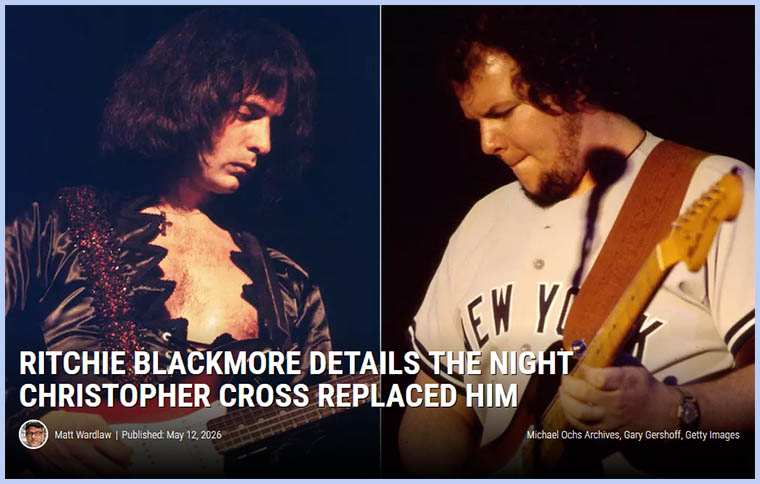 Ritchie Blackmore Remembers Being Replaced By Christopher Cross Deep Purple shared the stage with Christopher Cross on August 28, 1970 at the Jam Factory in San Antonio. The twist? Cross was filling in at the last minute for the band's regular guitarist, Ritchie Blackmore. "I must have had a virus or something, because I had a canker sore in my mouth under my tongue," Blackmore tells UCR in a new interview. "So I couldn't eat, I couldn't speak. I was miserable about that and I wasn't happy about being on tour in America. I loved Europe, [but] America, it was so far apart in the places we played in. I had no idea where I was. I wasn't in my comfort zone and I kind of missed England." Why Ritchie Blackmore Missed the Deep Purple Concert That night in San Antonio, things came to "a climax," in his telling. "I remember being very miserable and I was walking down the corridor with Jon Lord to go to the show and then I felt very dizzy," he says. "I grabbed hold of Jon, and he kept me walking. Then I fell down and they took me to the hospital. They didn't know what it was. I think it was just pure misery. And they kept giving me shots in the hospital." [Blackmore chuckles lightly at the memory] The situation became more and more frustrating for the guitarist. "The doctors would say, Where's the pain? What do you feel? I go, I just don't know. I'm just so miserable," he reflects. "It was interesting, they said the week before, apparently they'd had Keith Richards in for a similar kind of experience, which I kind of wondered about." "I just stayed in the hotel being miserable and [Deep Purple] went on and did the show with, I think his name is Christopher Cross or something," he says. "[It] was some other guitarist and luckily, they played, because it's a terrible feeling when you're sick on the road and you let everybody down. You're letting the audience down, the crew down and the band down. Nobody wants to be sick on the road. But it does happen a lot." "I can get quite depressed," he says. "And I was very depressed at the time being in America and knowing that I'd be there for three months before I got back to England." What Does Christopher Cross Remember About That Night? It's a tale he's shared a number of times in the years that have followed, even getting longtime friend Eric Johnson to corroborate the night's events as word began to circulate that late Deep Purple keyboardist Jon Lord had dismissed the story as not being factual. Other Purple band members have similarly denied the temporary pairing of Cross with the band. But Cross stands by his account of what happened. "They didn't really want to cancel the show if they could help it,” the soft rocker recalled in the book The Yacht Rock Book: The Oral History of the Soft, Smooth Sounds of the 70s and 80s. A local promoter named Joe Miller was handling the Purple show and also "kind of managing" Cross at the time. "And Joe Miller said, 'Y'know, there's this guitarist in town who's a big fan of Ritchie's and he could probably step in.'" Taking Miller's suggestion, Deep Purple welcomed Cross to the lineup for the night. "I came down, and I had a Flying V and long hair, and I'm this big Ritchie fan. So we played the songs that I knew and then we jammed some blues. And they told the crowd Ritchie wouldn't be there. It was a great moment for me," he said. "And then, when they left town, I went to the airport and got to meet Ritchie, and he thanked me for covering for him. He was cool." 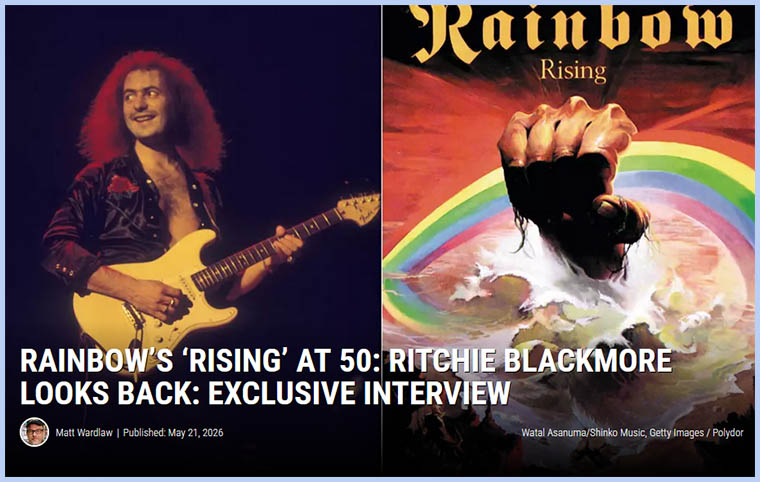 Ritchie Blackmore's time with Deep Purple was clearly running out. As the guitar legend told us in a rare interview, he'd grown weary of being part of the future British hard rock legends' ongoing musical exploits and the drama that came along with it. He freely admits in the conversation below that he recognized he was part of the problem. A change seemed like the right move to address the disgust he felt within himself, but at the same point, he was frustrated with his bandmates too. "When I left Deep Purple, I just felt that the band wasn't pulling [its weight] as a musical venture," he explains. "It became a committee. It was like if there were some answers to be had, there were five different answers. And I got a little bit tired of the committee meetings." A new box set chronicles what came next for Blackmore, with Ronnie James Dio and the new band the pair assembled, Rainbow. The Temple of the King: 1975-1976 offers a deep dive into the group's first two albums, 1975's Ritchie Blackmore's Rainbow and Rising, which followed in 1976. Though interviews with Blackmore are scarce these days, he agreed to answer questions, including sharing the story for the first time of why he was replaced on stage for one night in San Antonio on guitar by future soft rock balladeer Christopher Cross. In the first part of our interview, he detailed his recent health struggles, how he's feeling now and his departure from Deep Purple. Today, in the second installment, he discusses (often, with a bit of humor and sarcasm) how he moved forward with Rainbow and looks back at the Rising album as it turns 50 this week. From your point of view, how were you further evolving with these first two Rainbow albums? I would imagine that each one represents a memorable chapter for you personally, as far as what was accomplished, and at the same time, learned. I don't believe in evolving. Number one, I don't really understand the word and I was just uncomfortable. So it was time to move on and do other things. I'd been in Purple, I think, for seven years. And I think I got the feeling that we'd done everything we could do in our type of music. I did notice a lot of egos coming and going, so that was tiring. I just wanted to play music and not have any egos. The biggest ego of all of them was me, and I was kind of disgusted with myself at the time, so I thought, "I want to move on. I want to be away from myself." I found that difficult, but David Copperfield helped me out. He said, "I can make you move from yourself and be in the audience at the same time that you're on stage." And I said, "Okay, carry on." So that's where I went with that. I went to Las Vegas and joined David Copperfield's crew. He taught me exactly how to be in two places at once, and I paid him handsomely for what he did and that was it. How do you think you and Ronnie challenged each other as writers and creatives. We had a couple of old ceremonial swords, so we went out the back and we fought it out around his house. That's how we challenged each other. But realistically, challenging never came into the equation. We always got along very easily. It was very easy to write with Ronnie, because he was been a trumpeter in an orchestra. So he was very musical. Sometimes at rehearsals, he would say to me, "What are you hearing in this?" I would go up to him and as we were all playing as a band, I would kind of hum or whisper in his ear what I thought maybe the idea [could be]. And he instantly got the idea of where I was going and that's how we made most of our music. He was very quick to write lyrics, although I never really understood some of the lyrics. And I would ask him, "What's 'Man on the Silver Mountain,' What's that?" And he would go, "I don't really know, [it's] just something I thought of as a spur of the moment [thing]." Which, you know, I think everybody has their own silver mountain that they can pretend to have so sometimes lyrics don't have to make perfect sense. Okay, what did you appreciate about what Ronnie brought to your music? Working with Ronnie was very easy. When we first put down a couple of songs on a recorder that we had, he wasn't singing the usual heavy metal song. What he was singing, it was like renaissance, a 1500 kind of melody, to a lot of the ideas I had, which I was very impressed with his interpretations. He was obviously a very clever guy and it never took him more than 10 minutes to come up with something as far as the melody goes, although sometimes I would give him a melody in which he would use. But he was very quick on the uptake. I think, Ronnie, in his own way, it's kind of strange. Because I think he would spend more time watching baseball than he would actually writing a song. Because he could write a song so quickly that he would write it in 10 minutes and then go back to his baseball, which he loved. So that's it was very easy to write with him, and there was so much continuity. Immediately, he seemed to know what page I was on when I was trying to come up with certain ideas, and I hadn't really had that took me the towards the end with purple, there was a lot of discontent and a lot of scattered thinking, and very difficult to get everybody together in the same room. So it was such a pleasure just to be able to sit with a guitar play something, and the man knew exactly where I was going with it, and I really didn't have to do much coaxing or helping him, because he basically helped himself. He was a magical guy. Overall, what are some of the moments that really stick with you about recording that first Rainbow album? Doing the first Rainbow album was tricky in a way, because I had nothing worked out, hardly. I didn't know what I was doing. I didn't know where I was going. And at the time, there was a lot of different people involved with the management side of things, so everything was very tricky. So I was just glad that I could put down, I think it was 10 or 11 songs and I think a couple of the songs were good and I think a couple of the songs were a bit weak. But I did it, I think, in that three weeks. So it was something that I had not thought through properly. I just played whatever came to mind at the time and I didn't quite know what style I even wanted to play. That's why some of it's very melodic and some of it's very heavy. I was torn in between the two type of styles. If you believe that, you'll believe anything. It seems like the shows the band played in the last half of 1975 were an important driver that influenced material and ideas for Rising in a pretty interesting way. Well musically, that period, I was becoming comfortable in my own skin. The second time we approached stuff for Rainbow, I knew more or less where I was going, which was more heavy, but yet with an accent on melody. So as opposed to the first record, which I really didn't have much of an idea what I wanted to do, the second one, I was much more adamant about what I personally wanted to get across, especially with things like "Stargazer" and heavier songs. Ronnie was [also] coming into his own with his tone and his way of thinking, because, like I said before, we were both heavily into light kind of music in the beginning, but then when Rising came along, we were turning into a very heavy rock band, which I didn't mind at all . Because that's one of the styles I love to play. And obviously Ronnie was on board with that style too. Cozy [Powell] was always a heavy hitter, so he was the right guy for us at the time. We went our merry way, which was down the hard rock road. And I was feeling much more comfortable with being in a studio, without being in the studio with [Deep] Purple. This is the second record that I made with other other members and other musicians, so I was getting kind of used to being in the studio and feeling more comfortable than I was in the beginning. The live shows in this box set are special to have. You'd gotten to do your share of improvisation with Deep Purple, but looking at the variety each night with the three shows here, it feels like you had a blank canvas each time you stepped on stage. On stage, which is my favorite place to be. I do like to improvise. And I do like to play certain songs different ways, which confuses everybody. But I do like playing games and almost playing one song differently every night, so that it keeps people on their toes, including myself. I would say that what drove a lot of the nights. I know what it drove me was it drove my anger. I seem to be very angry on stage [through] that music that we were playing, I kind of opened up that kind of corridor of thought that it was anger that we were expressing to the audience, and the audience was picking up on it, because I could tell that people in the audience, they were angry too, although they loved it. It was an escape valve for everybody's anger. So a lot of Rainbow songs relied on this angry interpretation, which the guy who did the nine to five job in the audience with the denim jacket, he was angry too. So we were all in unison and sympathetic to each other, that we were all [fed up with how we were being treated] by people and and how angry you can be, and it's just a way of getting that anger out which, which I did every time I came on stage. You know, it was a great release for me. But Cozy was pretty angry. I was angry and Ronnie was angry. With three angry guys, [we were] kind of pushing to express our music that we felt wasn't being heard enough on the radio, because the radio was playing all schmaltzy kind of stuff, especially in England. It was quite interesting how they would not really go near our stuff. We were considered too heavy and too loud and too aggressive, but we enjoyed it. And of course, we were playing to packed houses, so I assumed there was a lot of angry people out there that enjoyed our anger. © Eduardo Rivadavia / Matt Wardlaw, Ultimate Classic Rock - May 2026  |